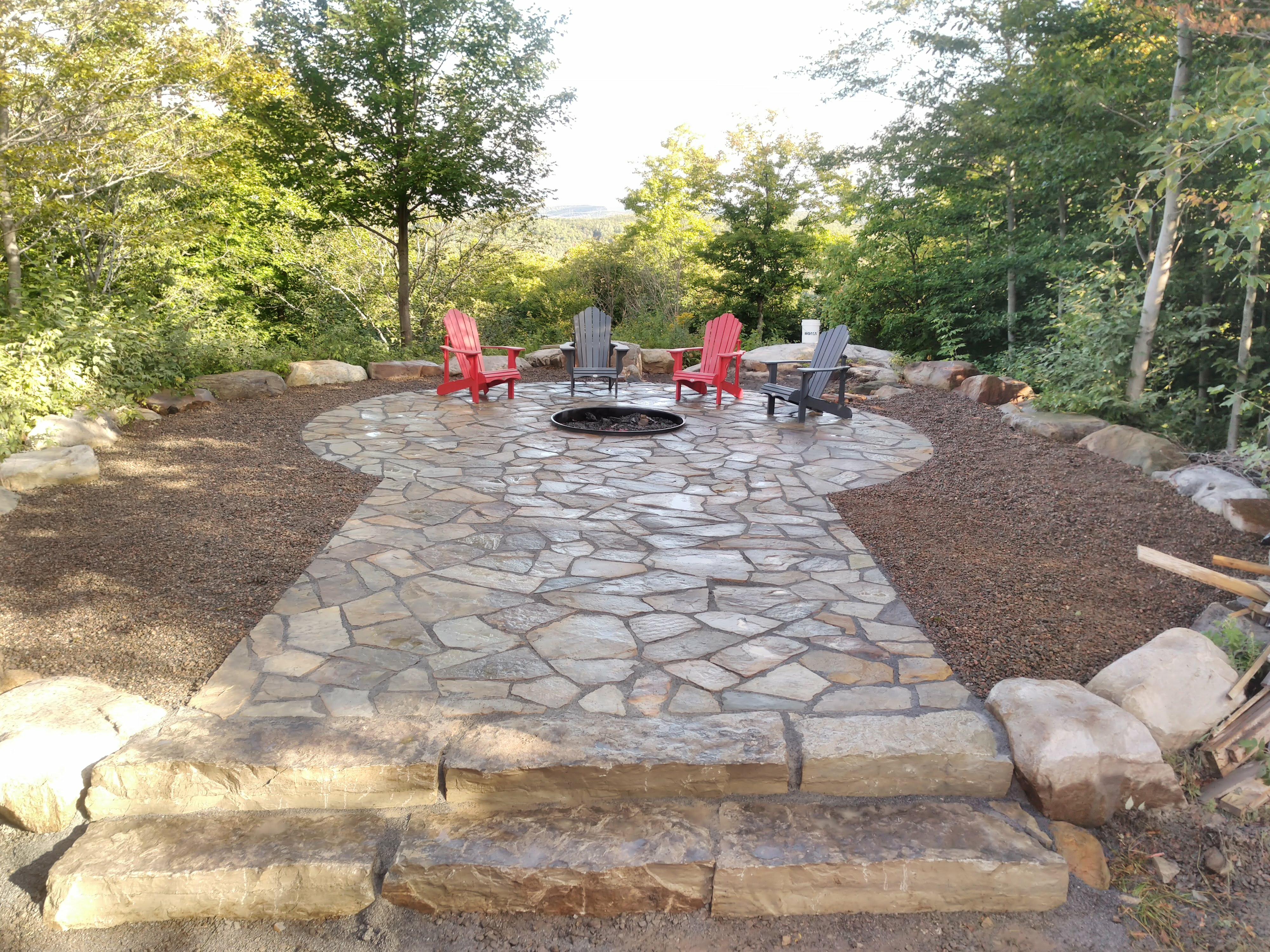
Terrace of irregular natural stone slabs with a fire pit, large stone steps and a border of raw boulders, built by Les Aménagements Spectaculaire
Natural stone terrace

Natural Stone Terraces & Slabs

Natural stone slabs, monolithic steps, stepping stones and terraces, hand-laid on a drained base. Free estimate with on-site visit.

In brief

  • What this page covers: The ground plane: natural stone slabs, terraces, monolithic steps, stepping stones and paths. For walls, see our Stone walls page.
  • Installation: Slabs laid by hand on a mortar bed or stabilized crushed stone, in an irregular pattern (opus incertum) or cut large format.
  • Service area: Saint-Joseph-du-Lac, Mirabel, Saint-Eustache, Deux-Montagnes, Boisbriand and the rest of the Lower Laurentians. Free estimate with a visit.

A natural stone terrace: the ground first

When people think of natural stone in a garden, walls often come first. This page is about the ground: the stone slabs of a terrace, patio or pedestrian entry, the steps leading to it and the paths that connect parts of the yard. For the overview of the stones we lay (Saint-Marc limestone, Canadian Shield granite, slate, Mirabel sandstone), see our natural stone page.

Slabs: irregular pattern or large format

Flat natural stone goes down in two ways. In an irregular pattern (opus incertum), slabs of varied shapes fit together like a puzzle for a natural look. In cut large format, the slabs are cut for a cleaner, more contemporary feel. Either way they sit on a mortar bed or stabilized crushed stone. The natural texture of the stone is generally slip-resistant, and it runs cooler than pavers in midsummer.

Monolithic steps and stepping stones

To reach the terrace, monolithic steps are whole blocks of granite or limestone, 1 to 2.5 metres long, laid without visible joints. For a path across the yard, stepping stones are placed by hand and spaced to a natural stride. If a rustic look appeals to you, our page on fieldstone covers that other option.

Natural stone or interlock paving for your terrace?

Interlock paving is still the best choice for a driveway. Natural stone excels on back terraces, access steps and pedestrian areas, where the character of each piece adds value. Many projects combine the two: interlock for the driveway, natural stone for the terrace. To plan the terrace as part of the whole yard, see also our backyard landscaping page.
What we lay

From the terrace floor to the steps

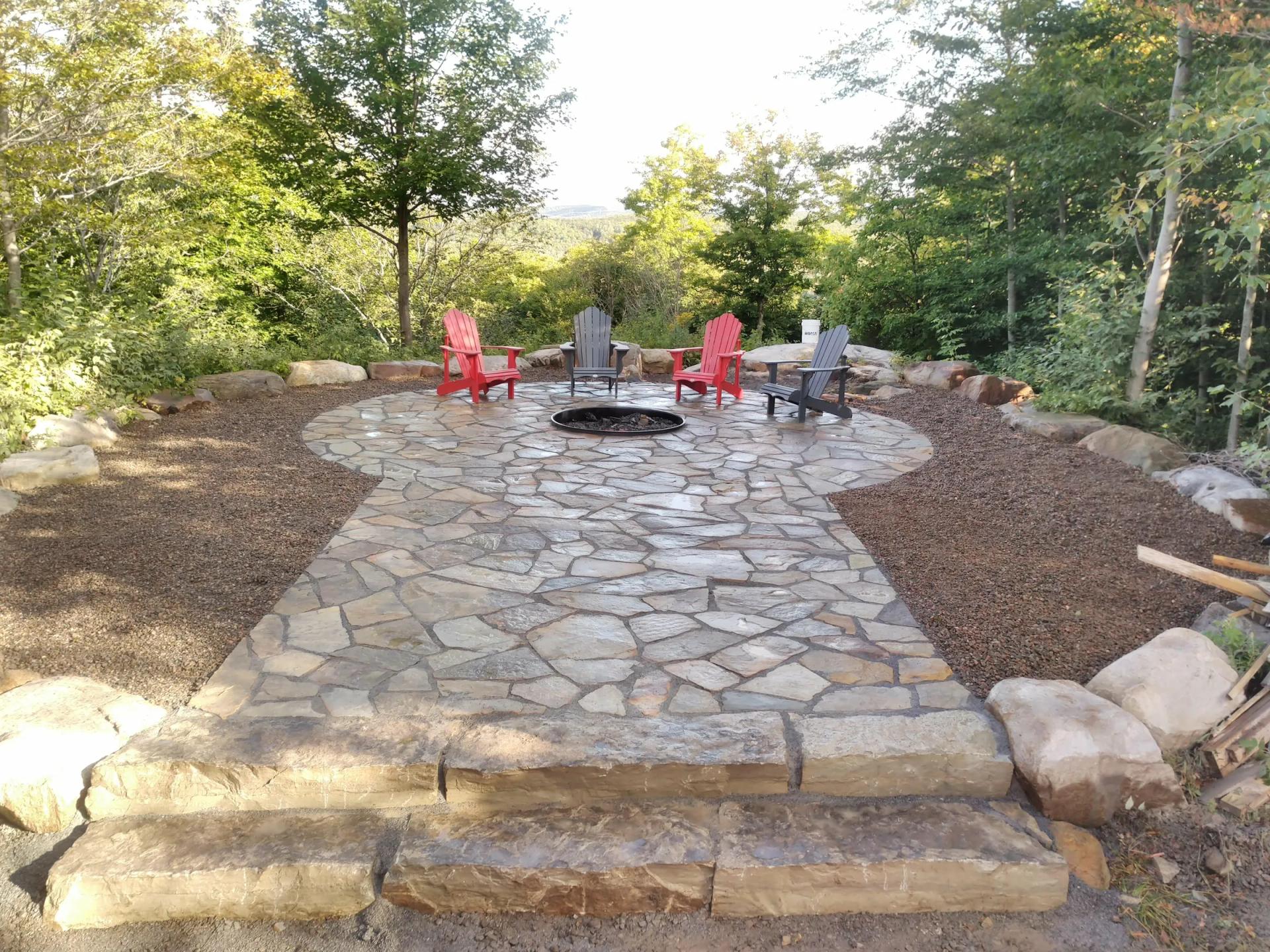
Irregular-slab terrace

Natural stone slabs of varied shapes, assembled in an irregular pattern (opus incertum) on a mortar bed or stabilized crushed stone.

Cut large-format slabs

Natural stone paving cut for a cleaner, more contemporary look while keeping the stone's natural texture.

Monolithic steps

Whole blocks of granite or limestone, 1 to 2.5 metres long, laid without visible joints: a sculptural effect manufactured pavers don't replicate.

Stepping stones & paths

Stones placed by hand and spaced to a natural stride, on a crushed-stone base to prevent sinking.

Choosing the stone

Saint-Marc limestone, Canadian Shield granite, slate and schist, Mirabel sandstone: we steer you by style, use and budget.

Base & drainage

A reinforced sub-base of 40 to 60 cm of crushed stone compacted in layers, planned around how water drains before any slab goes down.

What matters in a stone terrace

Hand-laid, no subcontracting

Natural stone laying doesn't mechanize like interlock paving: every slab is fitted, laid and jointed by hand by our own team.

Adapted base and drainage

Heavy stone needs a reinforced sub-base and good drainage. Without that invisible work, even the nicest terrace shifts by the first winter.

Stone picked at the quarry

For each project we visit the quarry to pick the stones. You validate the key pieces (steps, main slabs) on photos before cutting.

5-year workmanship warranty

Every wall, terrace or fireplace in natural stone laid by our team carries a 5-year workmanship warranty, with a free annual inspection in year one.

Natural stone terraces: frequently asked questions

Which natural stone should I choose for a terrace?

It depends on the style. Shield granite suits high-end terraces, slate and schist suit contemporary ones, Mirabel sandstone suits residential patio paving, and Saint-Marc limestone gives a grey stone that handles freeze-thaw well. We advise at the estimate, based on use, style and budget.

Natural stone slabs or interlock paving for my terrace?

Natural stone excels on back terraces, steps and pedestrian areas, where the character of each piece counts. Interlock paving remains the best choice for heavy-vehicle driveways. More and more projects combine the two.

Is a natural stone terrace slippery?

The natural texture of stone is generally slip-resistant, though that depends on the stone chosen and its finish. We discuss it when choosing the slabs, especially for steps and areas exposed to water.

How long does a natural stone terrace take?

Expect 4 to 8 weeks between signed estimate and project start in peak season (May–July), then about 2 weeks on site for a 50 m² terrace. Lead times shorten in September–October, and quarry selection adds 1 to 2 weeks for custom pieces.

How much does a natural stone terrace cost?

Price depends on the area, the stone chosen, the foundation and drainage required, the steps and site access. Rather than a generic price, we quote your exact property during a free on-site estimate.

A natural stone terrace, steps or path? We come out, assess the ground and give you a free detailed quote, with the stone, base and drainage that fit.

See also: Natural stone · Interlock paving · Backyard landscaping · Natural stone in Saint-Joseph-du-Lac